Over the lifetime of the programme, CEOI has funded a wide range of technology development projects, the majority of which have led to instruments which are now flying or scheduled to fly in satellite missions. These have been summarised in the figure below:
Many of these projects have been summarised as a Case Study and you can find out more by clicking on the links below:
- Dual benefits of novel nitrogen dioxide remote sensing instrument Led by Edinburgh Innovations
- Secrets of the upper atmosphere could be unlocked with new sensor Led by RAL Space
- Development of specialist space ‘radio’ set to establish UK as global leader in high-frequency technology Led by RAL Space
- Revolutionising weather forecasting with global surface pressure data from space Led by RAL Space
- Context Imager – Intelligent imager set to accelerate on-Earth response times to climate emergencies. Led by Craft Prospect.
- TRUST – New in-orbit calibration system set to provide ‘unprecedented’ accuracy in flight temperature measurements. Led by RAL Space and the National Physical Laboratory (NPL).
- HyMS technology is set to reinvent how the world approaches weather forecasting. Launch of Spire Global’s Hyperspectral Microwave Sounder (HyMS).
- Ultra-low-light camera – a highly sensitive camera system set to overcome some of the most significant challenges faced by Earth observation missions – night-time conditions and low light. Led by XCAM Scientific Ltd and supported by Fairchild Imaging.
- WIVERN – a new satellite which measures in-cloud winds for the first time. A collaboration between the University of Reading, the University of Leicester and RAL Space.
- SOLSTICE – a ‘Game changing’ new space instrument set to plug gap in crucial climate change data. Led by RAL Space in collaboration with Bright Ascension and Open Cosmos.
- HydroGNSS – a mission to measure climate change variables relating to Earth’s water cycle. Led by Surrey Satellite Technology Ltd.
- Umbrella Radiation Monitor – a novel instrument measuring near-Earth space radiation environment in real time. Led by Dr Hubert Hu, Founder of Umbrella Space Science Ltd.
- Broad Horizons – A space instrument that can image the entire disk of the Earth at a spatial resolution between 2km and 4km per pixel. Led by the University of Oxford in collaboration with Durham University
- Hibiscus – A thermal infrared space telescope for Earth Observation to tackle some of the world’s most pressing challenges. Led by the team at SuperSharp.
- BABEL – A Novel Microwave Geolocation System for Earth Observation Applications. Team led by In-Space Missions Ltd
- HYMS – Hyperspectral Microwave Sounder for Spaceborne Earth Observation. Team led by STFC RAL Space. Partners: STAR-Dundee Ltd and JCR Systems.
- GRaCE: G-band Radar for Cloud Evaluation. Team led by STFC RAL Space. Partners: Thomas Keating Ltd, University of Leicester and University of St Andrews
- The Compact Infrared Imager and Radiometer (CIIR). Team led by University of Oxford. Partners: RALSpace and Clyde Space
- Traceable Radiometry Underpinning Terrestrial- and Helio- Studies (TRUTHS). Team led by NPL. Partners: Surrey Satellite Technology Ltd, Airbus DS, STFC RAL, Imperial College London & University of Reading
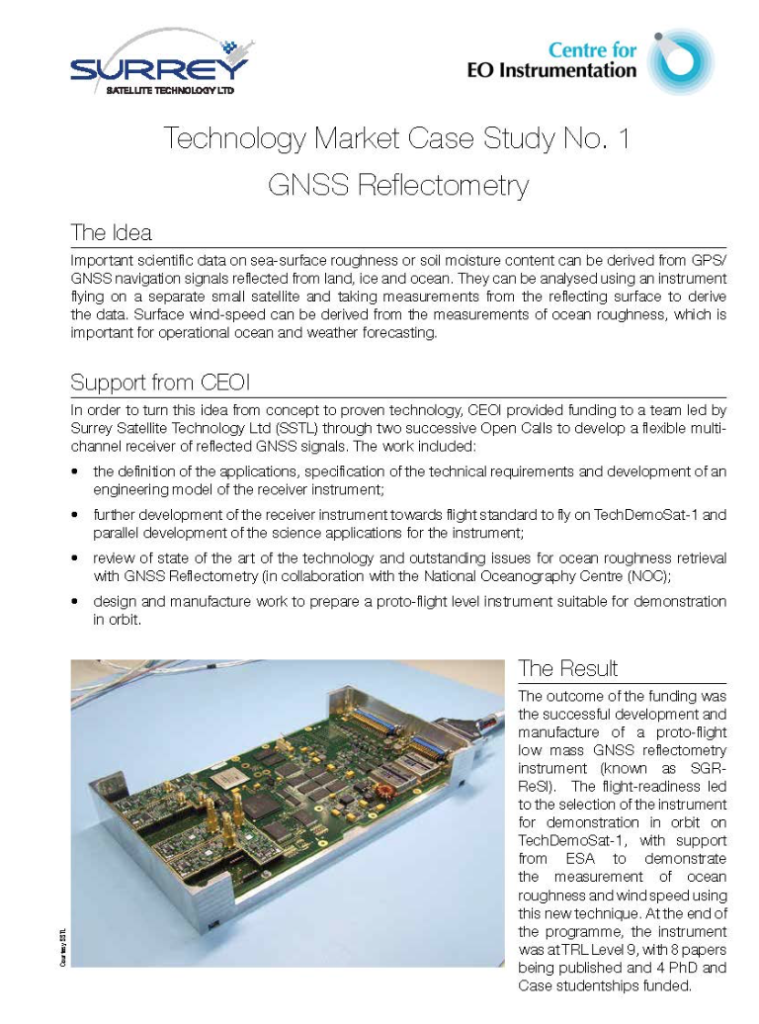
- GNSS Reflectometry. Team led by Surrey Satellite Technology Ltd (SSTL)
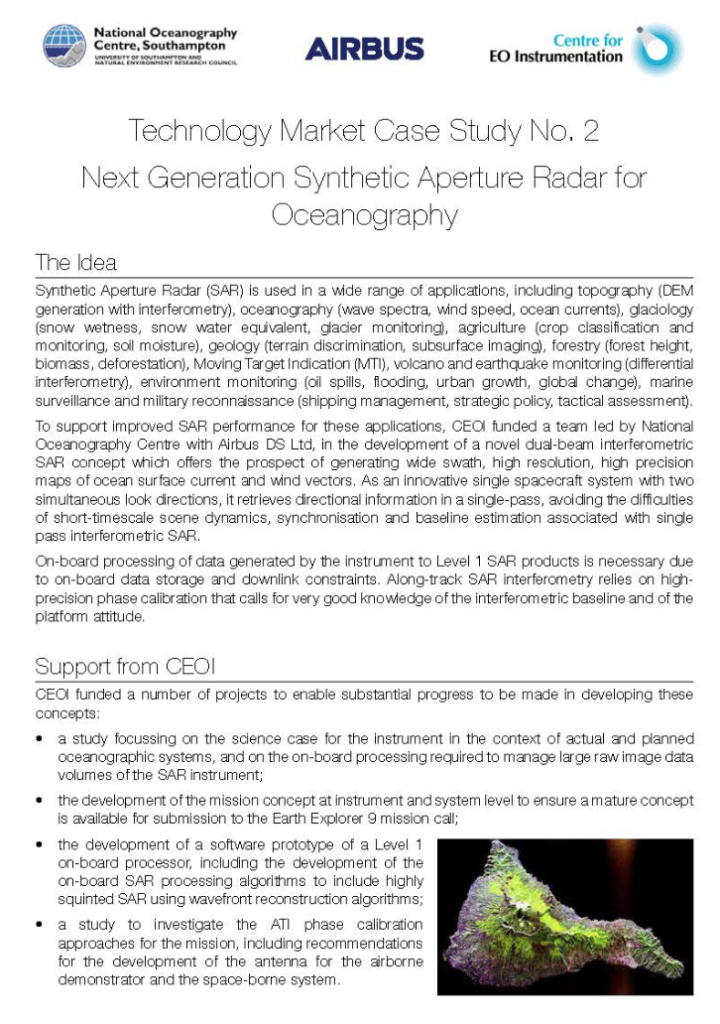
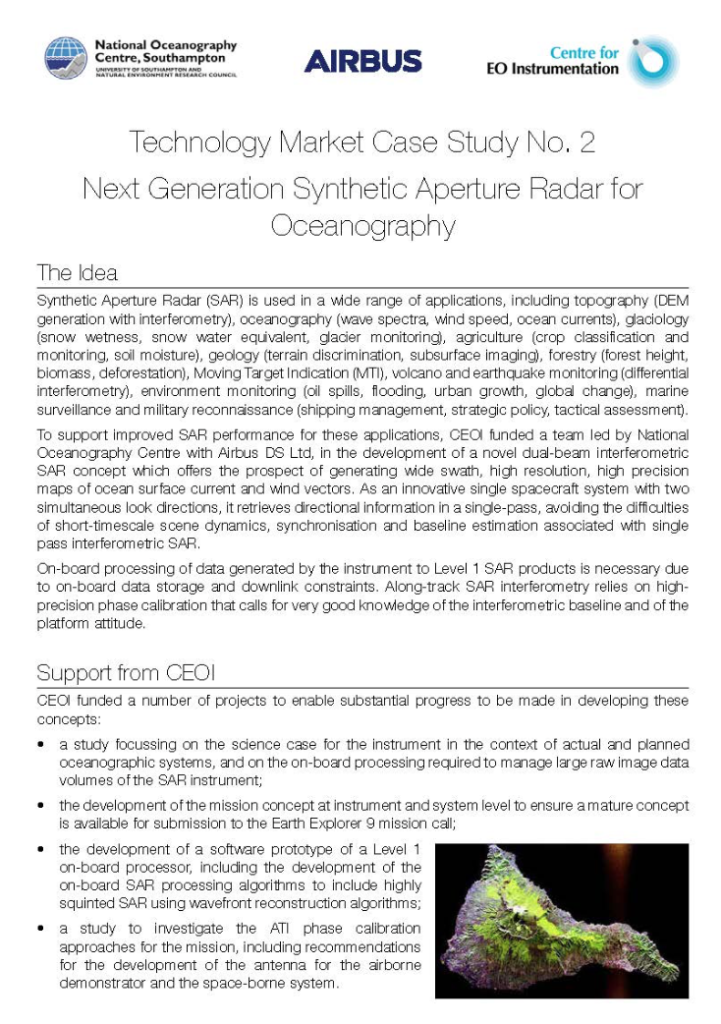
- Next Generation Synthetic Aperture Radar for Oceanography. Team led by National Oceanography Centre with Airbus DS Ltd
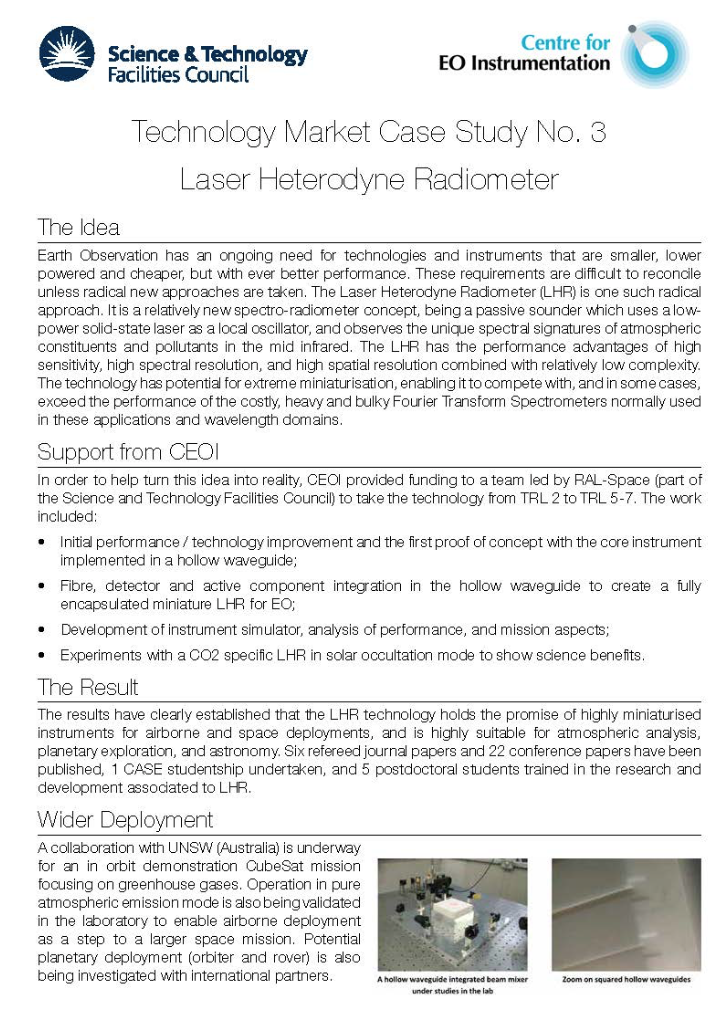
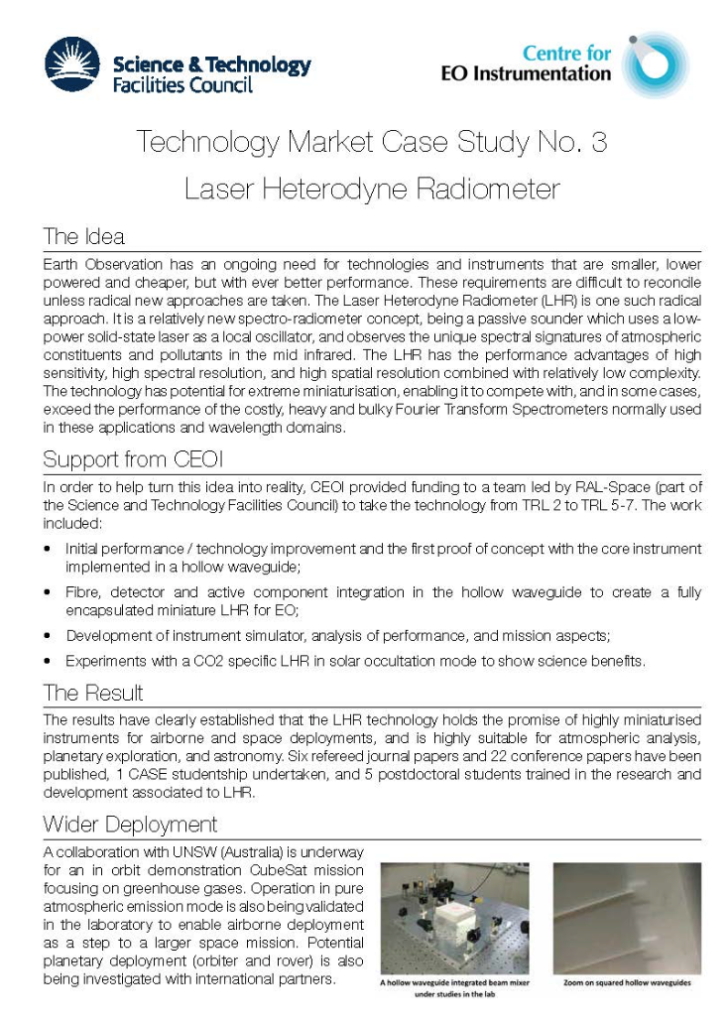
- Laser Heterodyne Radiometer. Team led by RAL-Space (part of the Science and Technology Facilities Council)
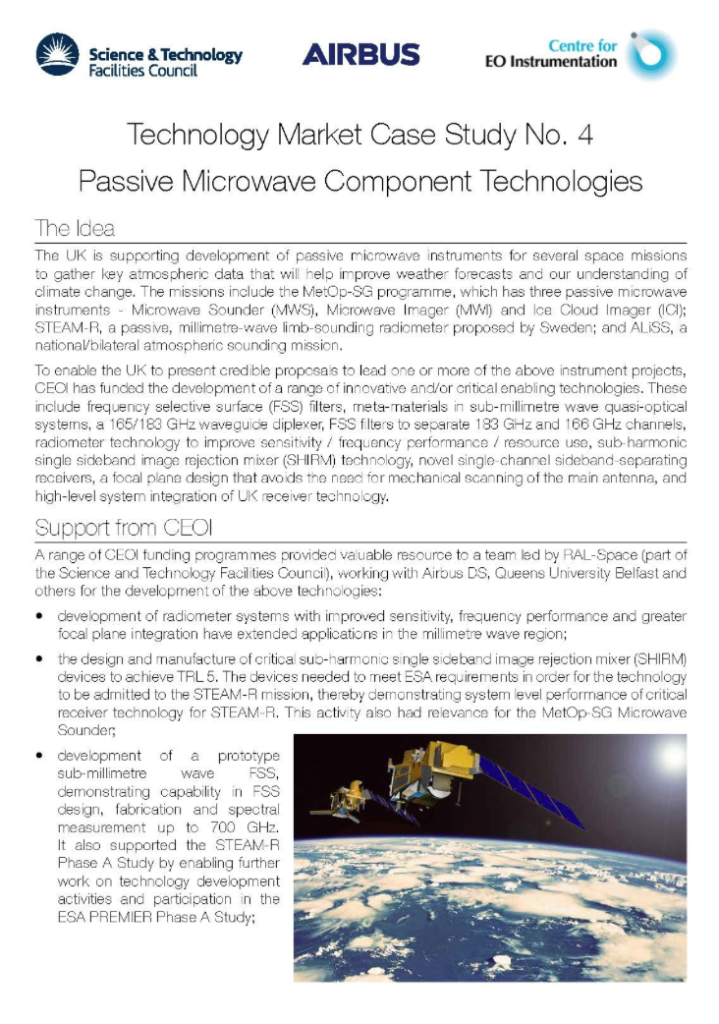
- Passive Microwave Component Technologies. Team led by RAL-Space (part of the Science and Technology Facilities Council), working with Airbus DS, Queens University Belfast and others
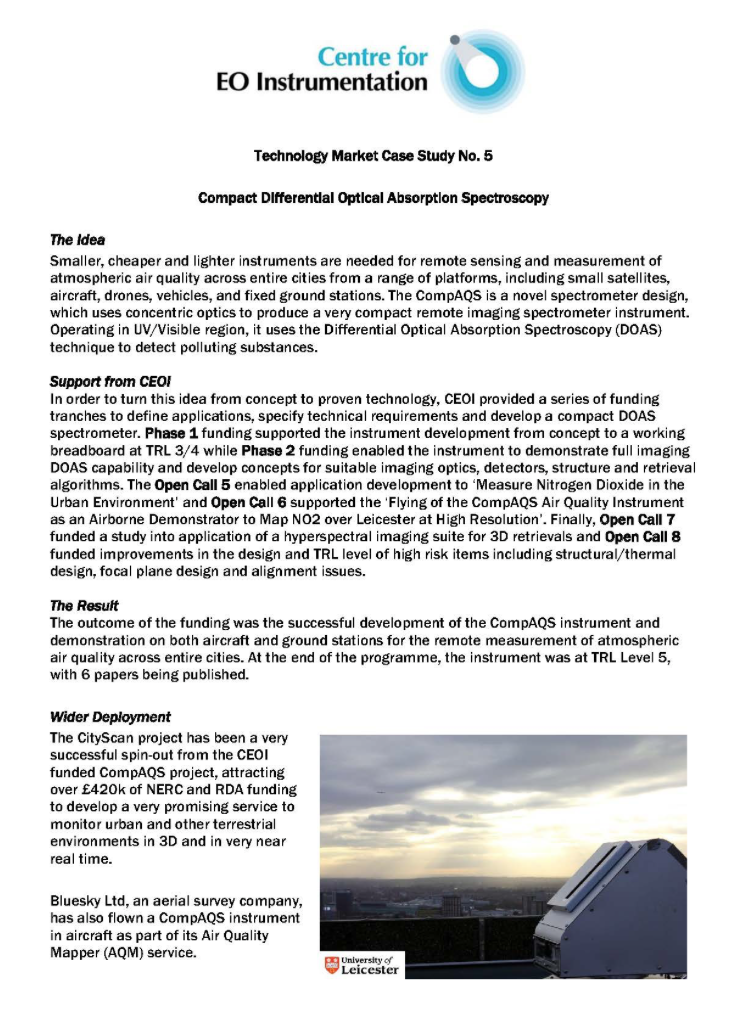
- Compact Differential Optical Absorption Spectroscopy. Team led by University of Leicester, working with Surrey Satellite Technology Ltd.
- Terahertz Multichannel Radiometer Using Stabilised 3.5-THz Quantum-Cascade Laser Local Oscillators and Schottky Diode Technology. Team led by the University of Leeds.
- OVERPaSS: On-board VidEo Rapid ProceSSing. Team led by Earth-i Ltd
- Phase Change Cells for Next Generation InfraRed Calibration Sources (NGenIRS). Team led by RAL-Space working with Surrey NanoSystems and National Physical Laboratory